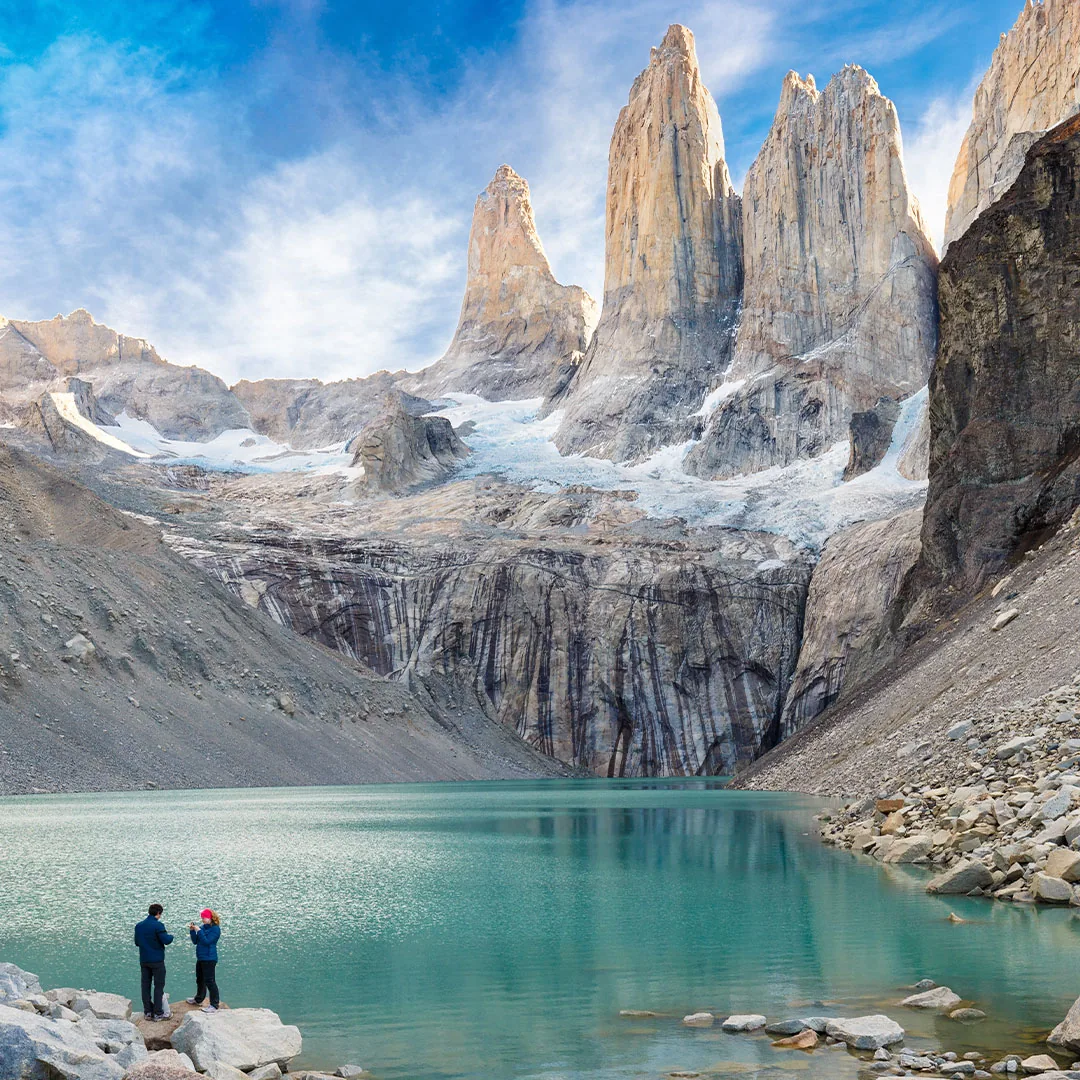
Hiking Trails: Torres del Paine National Park
The W Trek is Patagonia's most celebrated multi-day hike, tracing a 'W' shape through three spectacular valleys in Torres del Paine National Park. Over 4-5 days you will witness massive glaciers, dramatic granite towers, and turquoise lakes while staying at mountain refugios along the route.
Updated for 2026–2027 Season9 min read
Overview
Covering approximately 80 km, the W Trek connects three iconic valleys: the Torres (granite towers), the French Valley (hanging glaciers and the Paine Massif), and Grey (the colossal Grey Glacier). Most trekkers walk east to west, starting at the Torres sector and finishing at Glacier Grey, though the reverse direction is equally valid. All refugio and campsite reservations must be booked months in advance, as capacity is strictly limited. A car rental in Puerto Natales gives you flexibility to reach different park entrances and manage shuttle connections.
The W Trek is rated hard overall, requiring 4-5 consecutive days of hiking with distances of 15-22 km per day and cumulative elevation gains of 500-800m. The Torres Valley moraine scramble is the most physically demanding section. Good cardiovascular fitness and experience with multi-day hiking are strongly recommended. The trail is well-marked throughout, reducing navigation challenges.
Plan this trek
Trails
Day 1-2: Base Torres Valley
hardout-and-backPermit RequiredDistance
19 km
Elevation Gain
+800m
Duration
8-10 hours
Type
out-and-back
The eastern arm of the W leads to the iconic Base Torres lookout, where three granite towers rise above a glacial lagoon. This is the most physically demanding day of the trek due to the steep moraine scramble at the end, but the reward is Patagonia's most photographed vista. Most trekkers arrive at the sector on Day 1, camp or stay at a refugio, and tackle the towers on Day 2.
Highlights
Waypoints
Hotel Las Torres / Welcome Center
0 km from start · +0m · 0 hours
The starting point for the Torres arm, reached by shuttle from Laguna Amarga park entrance or by car to the Hotel Las Torres parking area.
Refugio El Chileno
5.5 km from start · +400m · 2h 30min
A key rest stop and overnight option roughly halfway up the valley, with bunk beds, meals, and camping spots. Reservations required.
Campamento Torres
8 km from start · +600m · 4h 30min
The last campsite before the final ascent. Leave heavy packs here and carry only a daypack for the moraine section.
Base Torres Lookout
9.5 km from start · +800m · 6h 0min
The glacial lake reflecting the three granite towers. Arrive early for the best light and fewer crowds. The moraine scramble to get here is steep and rocky.
- • Layered clothing including waterproof/windproof shell
- • Sturdy waterproof hiking boots
- • Trekking poles (essential for moraine descent)
- • Daypack for the summit push
- • Headlamp for early morning starts
- • 2L+ water capacity
Permit Required: Yes — Park entrance fee required (payable online or at gates). All camping and refugio stays must be pre-booked through the concessionaire websites (Vertice Patagonia or Fantastico Sur) months in advance.
Trailhead Access: Most trekkers take a shuttle from Laguna Amarga park entrance to the Welcome Center near Hotel Las Torres. Driving a rental car from Puerto Natales to the Laguna Amarga entrance takes approximately 2 hours and provides the most flexibility for timing.
Water Availability: Streams available throughout the valley. Water can be purchased at Refugio El Chileno. Always filter or purify stream water.
Camping Options: Overnight options at Refugio Torre Central, Refugio El Chileno (beds and camping), and Campamento Torres (camping only). All require advance reservations.
Best Months: October, November, December, January, February, March
Day 3: French Valley
hardout-and-backPermit RequiredDistance
20 km
Elevation Gain
+700m
Duration
7-9 hours
Type
out-and-back
The central arm of the W ascends into the heart of the Paine Massif, revealing hanging glaciers, thundering avalanches, and the massive amphitheater known as the Frenchman's Wall. Starting from either Refugio Paine Grande or Refugio Los Cuernos, the ascent to Mirador Britanico rewards trekkers with a 360-degree panorama that many consider the highlight of the entire W Trek.
Highlights
Waypoints
Refugio Paine Grande
0 km from start · +0m · 0 hours
Western access point to the French Valley, reached by catamaran from Pudeto or by trail from Refugio Grey.
Campamento Italiano
7.5 km from start · +150m · 2h 30min
Unmanned campsite at the valley entrance. Leave large packs here before ascending. Basic facilities only.
Mirador Frances
10 km from start · +450m · 4h 0min
The first major viewpoint offering spectacular views of hanging glaciers and the Paine Grande massif.
Mirador Britanico
13 km from start · +700m · 6h 0min
The ultimate viewpoint with a full panorama of the French Valley amphitheater. The extra effort beyond Mirador Frances is absolutely worth it.
- • Waterproof and windproof layers
- • Sturdy waterproof hiking boots
- • Trekking poles for steep sections
- • Daypack for the valley ascent
- • High-energy snacks and lunch
- • Camera with charged battery
Permit Required: Yes — Covered by the park entrance fee. Camping at Campamento Italiano requires a reservation through the Vertice Patagonia system.
Trailhead Access: Access from Refugio Paine Grande (reached by catamaran from Pudeto) or from Refugio Los Cuernos on the eastern side. Driving a rental car to Pudeto for the catamaran departure is the most common approach.
Water Availability: Numerous streams flow through the valley. Filter or purify before drinking. No potable water points beyond Campamento Italiano.
Camping Options: Campamento Italiano (unmanned, reservation mandatory) is the only camping option within the valley. Most trekkers base themselves at Refugio Paine Grande or Refugio Los Cuernos.
Best Months: October, November, December, January, February, March
Day 4-5: Grey Glacier
moderateout-and-backPermit RequiredDistance
22 km
Elevation Gain
+500m
Duration
7-9 hours
Type
out-and-back
The western arm of the W leads to stunning views of the massive Grey Glacier and its floating icebergs on Lago Grey. This is the most accessible of the three valleys, with a relatively gentle grade through enchanted forests and along rocky shorelines. Many trekkers add an optional ice-hiking excursion on the glacier itself, bookable through local operators.
Highlights
Waypoints
Refugio Paine Grande
0 km from start · +0m · 0 hours
Starting point for the Grey arm, accessible by catamaran from Pudeto or as a continuation of the W Trek from the French Valley.
Laguna Los Patos
3 km from start · +50m · 1h 0min
A serene lake passed early in the hike, offering views back towards Paine Grande and the massif.
Guarderia Grey
8 km from start · +200m · 2h 45min
Ranger station with information boards. A good rest point before continuing to the glacier viewpoint.
Mirador Glacier Grey
11 km from start · +300m · 4h 0min
The main viewpoint offering expansive views of the glacier's calving front, with icebergs scattered across the lake below.
- • Layered clothing (waterproof and windproof)
- • Sturdy waterproof hiking boots
- • Daypack with water and snacks
- • Sunscreen and sunglasses
- • Binoculars for glacier viewing
Permit Required: Yes — Covered by the park entrance fee. Refugio Grey accommodation and camping require advance booking through Vertice Patagonia.
Trailhead Access: From Refugio Paine Grande, which is reached by catamaran across Lago Pehoe from Pudeto. Driving to Pudeto from Puerto Natales takes about 2.5 hours via paved and gravel roads.
Water Availability: Streams available along the trail. Water can be refilled at Refugio Grey. Always filter or purify.
Camping Options: Refugio Paine Grande and Refugio Grey offer both beds and camping. All stays require advance reservation, especially December through February.
Best Months: October, November, December, January, February, March
Drive to the Trailhead
Browse Car RentalsSafety Tips
- 1Book all refugios and campsites 3-6 months in advance; starting without confirmed reservations is not permitted.
- 2Patagonian weather changes within minutes — carry waterproof/windproof gear at all times, even on sunny mornings.
- 3Carry at least 2 liters of water and a filter; streams are abundant but must be treated.
- 4Stay strictly on marked trails; off-trail hiking is prohibited and can result in fines or park expulsion.
- 5Strong winds can exceed 100 km/h on exposed sections — use trekking poles and brace low during gusts.
- 6Campfires are strictly forbidden anywhere in the park; use only designated cooking areas at refugios.
- 7Carry a comprehensive first-aid kit and know basic wilderness first aid before attempting the full W Trek.
- 8Leave your itinerary with your accommodation in Puerto Natales and carry emergency contact information at all times.
Emergency Contacts
Rescue Service
136 (Chilean Mountain Rescue / CONAF)
Park Rangers
+56 61 223 8887 (CONAF Torres del Paine)
Nearest Hospital
Hospital Clinico Magallanes (Punta Arenas, approximately 3 hours drive from the park)
Planning the trails? Ask before you commit to dates.
Which days to book, what to skip, how to reach the trailhead — tell us your plans for Puerto Natales and we will come back with advice on timing and logistics.
The advice is free. Booking a car or a tour through us afterwards is entirely optional.
Message written for you — edit or send as is.
🥾 More Hiking Trails
📋 Practical Info for Torres del Paine National Park
Explore Torres del Paine National Park
More guides for this destination
Drive to the Trailhead
Rent a car to access the best hiking trails near Torres del Paine National Park
Explore More Guides
View all →Frequently Asked Questions
How far in advance should I book the W Trek?
Refugio and campsite reservations open approximately 6 months before the season starts (around June for the October-March season). Popular dates in December-February can sell out within days of opening. Book as early as possible, and have flexible dates ready as a backup.
Which direction should I hike the W Trek?
Most trekkers go east to west (Torres to Grey), which puts the most demanding day (Torres) first when energy levels are highest and ends with the gentler Grey Glacier section. However, west to east is equally valid and may have better availability for late bookers.
Can I do the W Trek without a guide?
Yes, the W Trek is well-marked and does not require a guide. However, guided options are available and can simplify logistics, especially for first-time trekkers in Patagonia. Self-guided trekkers must still pre-book all accommodation.
What is the difference between refugios and campsites?
Refugios provide bunk beds, hot meals (breakfast and dinner), and hot showers. Campsites provide a designated tent spot with access to basic facilities (toilets, sometimes cooking shelters). Both must be reserved in advance. Refugios are significantly more expensive but eliminate the need to carry a tent and cooking gear.
How do I get to the start of the W Trek?
Most trekkers base themselves in Puerto Natales and take a bus to the Laguna Amarga park entrance (2-3 hours), then a shuttle to the trailhead. Renting a car in Puerto Natales provides the most flexibility for arrival times and allows you to store luggage in the vehicle during the trek.
What happens if weather forces me to stop?
Park rangers may close sections of the trail during extreme wind or weather events. If this happens, trekkers wait at the nearest refugio until conditions improve. Build buffer days into your trip to account for potential weather delays — rushing due to a tight schedule increases risk.
Can I do the W Trek in 3 days?
While physically possible for very fit hikers, 3 days means very long days (30+ km) and missing the French Valley entirely. The standard 4-5 day itinerary allows you to fully enjoy each valley and reduces injury risk from exhaustion.
Is the O Circuit better than the W Trek?
The O Circuit (8-10 days) completes a full loop around the Paine Massif, adding remote backcountry sections not seen on the W. It requires more experience and fitness but rewards with solitude and wilderness. The W Trek covers the three most spectacular valleys and is ideal for most visitors.